PERKESO LINDUNG 24 Jam vs Group Personal Accident Insurance: What Malaysian Business Owners Need to Know
Last updated: 3rd August 2026. Reflects LINDUNG 24 Jam Phase 1 rates (2026–2028).
Everyone is talking about PERKESO’s LINDUNG 24 Jam right now. The opt-out deadline. The new payslip deduction. The confusion on WhatsApp and Facebook groups.
But most of that talk is from the employee’s side. As a business owner, you have a different question to answer.
It’s not “should I opt out?” It’s: “Is this enough to protect my staff, or do I still need to do more?”
Here’s an honest look at what LINDUNG 24 Jam covers for your workforce, where the gaps are, and how Group Personal Accident Insurance (GPA) fits in.
What Is PERKESO LINDUNG 24 Jam? (Quick Explanation)
LINDUNG 24 Jam is a new government scheme from PERKESO. You can read the official PERKESO page if you want the full details.
In simple terms, it protects your employees from accidents that happen outside of work. Think: a fall at home, a motorcycle accident on the way to a wedding, an injury during a weekend futsal game.
Here’s what matters most to you as an employer:
- It’s optional for local staff, but not really. If an employee does nothing, they get enrolled automatically. Only employees who actively opt out are excluded.
- It’s compulsory for foreign workers. No opt-out for them.
- Your staff pay for it, not you. The deduction comes out of their own salary. You don’t contribute extra.
- The cost is capped. The deduction is 0.75% of monthly wage, but only on wages up to RM6,000. You can check the current contribution rate table for the full breakdown.
- It covers a few different things: medical treatment for accident injuries, income during recovery, a payout for permanent disability, and support for the family if an employee dies.
Sounds fairly complete, right? Here’s where it gets more interesting.
3 Things About LINDUNG 24 Jam Most People Don’t Know
1. The payout is phased too, not just the deduction.
Most people know the deduction rate will rise over time: 0.75% now, climbing to 1.25% by 2031. Fewer people know the payout rises in the same phases.
Right now, in Phase 1, the payout for a non-work accident is lower than it will eventually be. PERKESO’s own rate schedule shows this clearly. Every page states it plainly: “Fasa 1 | FHUS 48% | FHUK dan FOT 54%”. In simple terms, a temporary disability payout is set at 48% of the full rate today. A permanent disability payout is set at 54%. Both climb to the full rate by 2031.
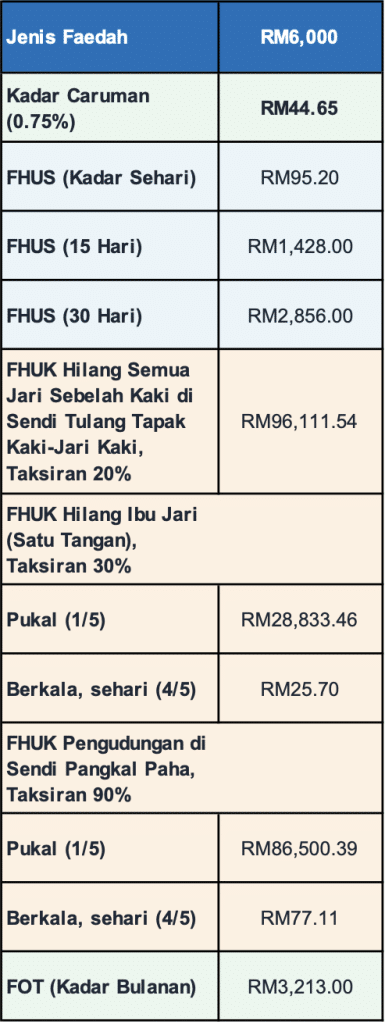
For example, at the RM6,000 wage cap, the daily temporary disability payout right now works out to RM95.20 a day. That number keeps rising as the scheme matures.
These benefit percentages aren’t hidden information. They’re written into the actual law (Section 18, Akta A1788). It just rarely gets explained in plain language.
2. The wage cap doesn’t grow with income.
The 0.75% deduction only applies to wages up to RM6,000 a month. Anything above that isn’t counted.
This matters more for supervisors, engineers, or senior staff than for production-line workers. Their protection stays capped at the RM6,000 level, no matter how much more they actually earn.
3. It only covers accidents inside Malaysia.
LINDUNG 24 Jam protects your staff for accidents that happen within Malaysia. If an employee travels overseas, for a supplier visit, a training trip, or a trade show, this scheme stops at the border.
If your staff travel for work even occasionally, this is worth thinking about.
So how does this actually compare to a private option like GPA? Let’s put them side by side.
LINDUNG 24 Jam vs Group Personal Accident Insurance: The Table
These two don’t really compete for the same job. LINDUNG 24 Jam works like a safety net. GPA works like extra cash in hand. Here’s what that looks like side by side.
- LINDUNG 24 Jam pays based on your employee’s wage. GPA pays based on an amount you choose to insure them for.
- LINDUNG 24 Jam pays a small lump sum plus ongoing daily payments. GPA usually pays one lump sum, right away.
- LINDUNG 24 Jam only protects your staff inside Malaysia. GPA usually protects them worldwide.
- LINDUNG 24 Jam’s payout amount is worked out case by case, based on wage, age, and a Medical Board’s assessment. GPA also needs medical proof for a claim, but its payout percentage is already fixed in the policy table, agreed before anything happens.
Here’s what that fixed table actually looks like, taken from a real Group Personal Accident policy.
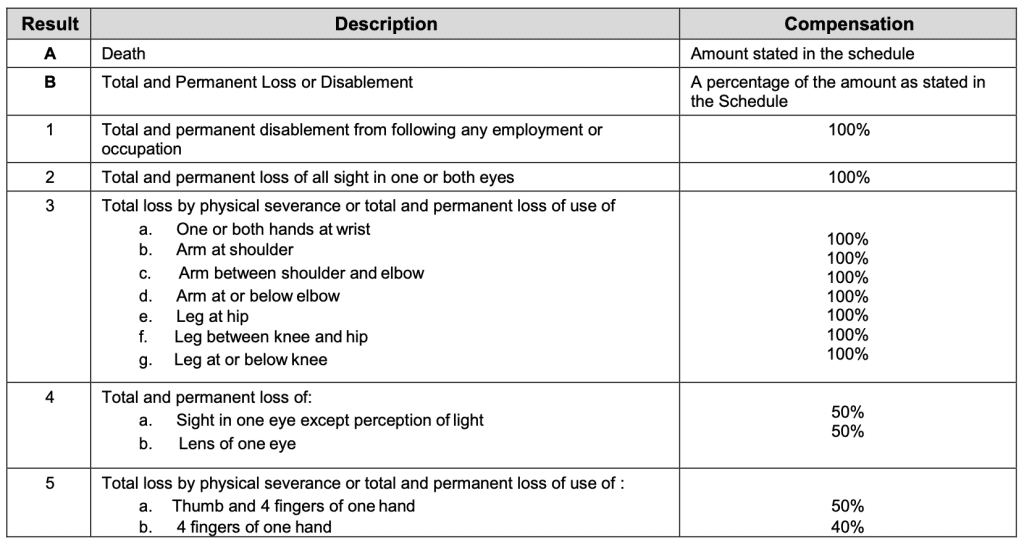
Notice how specific this gets. Losing a thumb and fingers. Losing sight in one eye. Losing all sight in both eyes. Each one has its own fixed percentage, agreed upfront. Your employee, or their family, doesn’t have to wait for an assessment to know roughly what they’ll receive.
So, Do You Still Need GPA for Your Staff?
Here’s the honest answer. LINDUNG 24 Jam isn’t bad. It’s compulsory or automatic for most of your workforce anyway, and the ongoing daily payments have real value for someone who can’t work for months after an accident.
But it has a real gap: the lump sum.
Let’s use the RM6,000 wage cap as an example. At that wage, PERKESO’s Phase 1 deduction works out to about RM536 a year, taken straight from your employee’s pay. If that employee becomes permanently disabled, the payout comes as a small lump sum plus daily payments, spread out over time.
Now compare that to GPA. Here, you choose the Capital Sum Insured yourself. It has nothing to do with wage, so even a lower-earning employee can be insured for a large amount, something LINDUNG 24 Jam can never offer. And it pays out as one lump sum, right away, not spread out over time.
For most wage levels, that lump sum ends up far bigger than what LINDUNG 24 Jam alone pays upfront.
Keep LINDUNG 24 Jam. Just don’t stop there.
The ongoing income from LINDUNG 24 Jam is genuinely useful. But if your employee needs cash quickly, for medical bills, home changes, or simply to keep their family afloat while they can’t work, a lump sum matters. That’s exactly what GPA is built for.
Want to understand GPA on its own, in more detail? We’ve written a full breakdown here: Group Personal Accident: Facts You Need to Know.
Working out your exact gap, for your specific wage bands, takes real numbers rather than a guess.
What To Do Next
Here’s a simple checklist for the next few weeks:
- Check your compliance status before 31 August 2026. If any of your local staff want to opt out, they need to do it before this date. Your foreign workers don’t get a choice. Just make sure they’re registered.
- Decide if a GPA top-up makes sense for your team. A common approach is to size the coverage as a multiple of yearly salary. The right multiple depends on your budget and your industry. If that feels like too much to work out alone, feel free to reach out and we can figure it out together.
- Know what’s standard, and what’s an add-on. A standard GPA policy already covers death and permanent disability, including injuries like a lost finger or hearing loss, just like the table above shows. What’s usually optional is temporary disablement cover. This is sometimes called “MC insurance,” because it pays your employee an income while they recover, based on their MC days. Decide if that’s worth adding for your team.
- GPA’s worldwide cover is a good base layer. It doesn’t replace dedicated travel insurance. LINDUNG 24 Jam stops at the Malaysian border. Most GPA policies don’t, so your staff stay protected even overseas. But for actual trips, supplier visits, conferences, training, we’d still recommend getting dedicated travel insurance. It covers more than GPA does: medical treatment abroad, trip delays, and emergency evacuation.
For a quick overview of employee benefit insurances, check out our Group Personal Accident and Group Hospital & Surgical Insurance page.
Common Questions
Does a claim under GPA affect our company’s future premiums? It can, depending on the insurer and your claims history over time. This tends to matter more for larger groups than smaller ones. Worth asking about directly when comparing options, since this varies quite a bit between insurers.
What if an employee already has their own Personal Accident coverage? Not much, for the main benefits at least. Death and permanent disability payouts under GPA are fixed amounts, not reimbursements, so they pay out in full no matter what personal cover an employee already has. The one real overlap is medical expense claims, if your policy includes that benefit, since the same medical bill can’t be claimed twice. That’s a small claims detail though, not a reason to hold back. The core benefits still add real value regardless of what employees already hold.
Can I choose which employees get covered, or does it have to be everyone? Not quite. Most insurers expect GPA to cover the whole company, or at least a clearly defined group of staff, not a hand-picked list of names. There are some standard exceptions, like an age limit. There’s also a practical side to this: staff tend to notice when coverage differs from person to person, and that can raise questions you’d rather avoid. Worth talking through properly before deciding how to structure it for your team.
Does GPA cover illness, or only accidents? Only accidents. If you want cover for illness too, cancer, heart conditions, and so on, that needs a separate medical or hospitalisation policy, not GPA. We’ll cover that gap in more detail in our next article.
How is the GPA premium actually calculated? It depends on the insurer, the Capital Sum Insured you choose, and the occupation risk of your staff. Office-based roles and higher-risk roles, like machine operators, are often priced differently.
What’s the real difference between GPA and travel insurance? GPA is an ongoing policy that protects your staff wherever they are, including overseas in many cases, but only for accidents. Travel insurance is trip-specific and covers more: medical treatment abroad, trip delays, lost baggage, and emergency evacuation. They work well together, not as substitutes for each other.
What happens to an employee’s GPA coverage when they resign? Coverage usually ends when employment ends, since GPA is tied to active employment. If someone wants coverage to continue after leaving, that would need to be their own personal policy instead.
Do I need to update my insurer when my headcount changes? Generally, yes. Most GPA policies expect updates when staff join or leave, so your coverage and premium stay accurate. Check your specific policy’s terms, since this can vary by insurer.
Is GPA the same for foreign and local workers? Not quite. Foreign workers in Malaysia already have their own required insurance scheme, separate from what’s typically arranged for local staff. That’s worth factoring into how you structure GPA for your team. If your workforce includes both foreign and local staff, it’s worth discussing directly rather than assuming one approach fits everyone the same way.
Can I add GPA cover partway through the year, or only at renewal? Most insurers allow you to add cover anytime, not just at renewal. New employees can usually be added as they join, with the premium adjusted accordingly.
About the author: Ernest Wong is the client-facing lead at SW Risk Control Services Sdn. Bhd. (SWRCS), a Shah Alam-based insurance agency serving Malaysian SME manufacturers across Business Interruption, employee benefits, and other commercial insurance lines.
Want to know what this looks like for your own team? Reach out and let’s have a quick chat. No charge, no pressure.
This article is for general information only. It is not insurance advice. Insurance terms and prices are different for each insurer. Please check the actual policy documents, or talk to a licensed insurance advisor, before making a decision.